My cousin Anuj works in tech. For three years, he's been telling me he "really should start stretching." His lower back has feelings about this. Loud ones. Last time I saw him in Bombay, he got up from a restaurant chair like a man auditioning for the role of a 70-year-old. He winced. He said, "I think I need yoga." He still hasn't started. I am not surprised. I am, however, mildly furious.
Anuj is not unique. He is, in fact, the global norm.
Read on for 6 yoga poses that specifically undo what desk work does to your body — with the anatomy and neuroscience of why each one works. I've prescribed all of these. They work.
In this article
- The Bridgerton Problem: what we lost when corsets left
- What sitting actually does to your body
- What Reddit says — and what the ergonomic chair crowd gets wrong
- The anatomy your physio won't explain properly
- 6 yoga poses for desk workers (with duration + why)
- The oldest posture instruction ever written
- FAQs
The Bridgerton Problem: What We Lost When Corsets Left
Watch any episode of Bridgerton. Every character — regardless of their personal disasters — walks as though their sternum is leading the way. Chests open. Shoulders back. Thoracic spines in full, glorious extension. Even Lady Danbury, mid-scandal, has better posture than most people I know under 40.
The corset is obviously a terrible idea. Nobody is arguing for the corset. But the corset did one thing accidentally useful: it forced the thoracic spine — the middle section of your back, from your shoulder blades to your lower ribs — into extension. It mechanically prevented the rounded-forward collapse that sitting at a screen encourages all day long.
We got rid of the corset. We kept the slumping. And then we all got laptops.
Now watch a single episode of The Bear. Carmy spends every scene hunched over a prep counter, shoulders collapsed inward, neck straining forward, spine in full flexion under pressure. He is also, incidentally, running on cortisol and barely sleeping. I watch it and I see the physical cost of a job that never lets your body decompress. Millions of desk workers have the same posture — with fewer knives, but identical spine mechanics.

What Sitting Actually Does to Your Body
Let's be specific. "Sitting is bad for you" is as useful as "eat better." Here's what actually happens, anatomically, when you sit for hours.
The Thoracic Spine Collapses
Your thoracic spine has a natural gentle curve. Prolonged sitting pushes that curve into hyperkyphosis — an exaggerated forward rounding. The muscles of your upper back (rhomboids, middle trapezius, thoracic erectors) lengthen and weaken from sustained stretch. The chest muscles (pectorals) shorten. Your head moves forward. For every centimetre your head moves in front of your shoulder line, the effective weight on your cervical spine increases by roughly 10 extra kilograms. This is what's called tech neck. It is exactly as glamorous as it sounds.
The Psoas Forgets Its Job
The psoas major is a long muscle running from your lumbar vertebrae through your pelvis to your femur. It is the only muscle connecting your spine to your legs. When you sit, it is held in a shortened position for hours. Over time it adapts. It stops fully lengthening. It starts pulling your lumbar spine forward — creating either a flattened lower back or an exaggerated arch — and tilting your pelvis out of neutral. A tight psoas is behind more mysterious lower back pain than almost anything else. My student Lisa came to me convinced she had a disc problem. She had a psoas problem. Eight weeks of targeted work later, she described the change as "embarrassingly dramatic."
The Nervous System Stays Switched On
Prolonged sitting — especially with poor posture — keeps the body in mild sympathetic activation. The compressed thorax limits deep diaphragmatic breathing. Shallow breathing signals to the brain: threat. The stress response stays partly engaged. You feel flat and wired simultaneously. This is not a mood problem. It's a mechanics problem.
If current sedentary trends continue, an estimated 500 million new preventable disease cases will emerge globally by 2030. To put that differently: that is more than the entire combined population of Brazil, Argentina, Colombia, and Chile — all getting sick, primarily from sitting. The global healthcare bill for physical inactivity between 2020 and 2030? $300 billion.

What Reddit Says (And Why the Ergonomic Chair Crowd Is Wrong)
The thread that appears constantly in posture and desk-worker forums: "I bought a $900 ergonomic chair and my back still hurts. What am I missing?"
Here's what they're missing. An ergonomic chair manages static posture. It supports the body in a position. It doesn't strengthen anything. It doesn't restore range of motion. It doesn't release a psoas that's been shortened since 2018. It's the equivalent of buying a very expensive mattress to fix insomnia — helpful, but it doesn't address the nervous system underneath the problem.
The second thread: "I tried 'desk yoga' — just the neck rolls and shoulder shrugs — and nothing changed."
Of course nothing changed. Neck rolls are approximately as useful for structural posture correction as moving the furniture around in a sinking ship. The work needs to happen in the thoracic spine and hip flexors — the two places desk work hits hardest — not the neck.
The Anatomy Your Physio Won't Fully Explain
A 2025 systematic review of yoga interventions for desk-based workers confirmed measurable improvements in musculoskeletal pain, perceived stress, and psychological wellbeing. A separate 6-month randomised controlled trial found yoga produced a 4.4% improvement in kyphosis angle — measurable structural change in the thoracic spine. A 2020 review of 34 clinical studies found yoga activates brain regions linked to proprioception — your body's sense of its own position in space. This proprioceptive re-education is what makes yoga posture correction different from simply "stretching."
Yoga doesn't just stretch tight muscles. It re-teaches the nervous system where the body is supposed to be — and gives it the muscular strength to hold that position without effort.
The second key mechanism: spinal extension poses — backbends, chest openers, anything that reverses the forward collapse of desk posture — have been shown to directly stimulate the vagus nerve by improving arterial baroreceptor sensitivity. The thoracic extension literally shifts the autonomic nervous system toward parasympathetic dominance. You open your chest and your stress response dials down. Mechanically. Not metaphorically.
Every time you do a proper backbend or chest opener, you are neurologically telling your stress response to stand down. Your posture and your nervous system are not separate conversations.
Curious how desk-tension bleeds into bad sleep? I've mapped the nervous-system overlap.
Deep Sleep Daily →6 Yoga Poses for Desk Workers — and Why Each One Works
These aren't generic yoga poses. Each one is chosen specifically for what sitting does to the thoracic spine, the psoas, and the autonomic nervous system. Do them in sequence if you can. Or pick the three most relevant to where your pain actually lives.
Cat-Cow
Marjaryasana — Bitilasana ⏱ 2 minutes · 10–15 slow cyclesStart on hands and knees. On an inhale, drop the belly, lift the chest and tailbone (cow). On an exhale, round the entire spine upward, chin to chest (cat). Move slowly and deliberately. This is not a warm-up throwaway. It is spinal mobilisation — systematically restoring range of motion in every vertebral joint that sitting locks into one position. The key is initiating the movement from the thoracic spine, not just the lower back. Most people cheat and only move their lumbar. Don't cheat. Feel each segment of the mid-back moving.
Low Crescent Lunge
Anjaneyasana ⏱ 90 seconds each sideFrom a standing position, step one foot forward into a lunge, lower the back knee to the floor. Keep the front knee over the ankle. Lift the arms overhead, draw the tailbone down, and feel the front of the back hip opening. This is the primary psoas release. The hip flexor of the back leg is in full stretch. Hold long enough to feel the muscle genuinely let go — usually after 45–60 seconds. Don't rush it. The psoas is stubborn. Anuj tried this once, held it for 20 seconds, declared nothing had happened, and walked away. That's not how releasing a muscle that's been contracting for three years works.
Supported Fish Pose
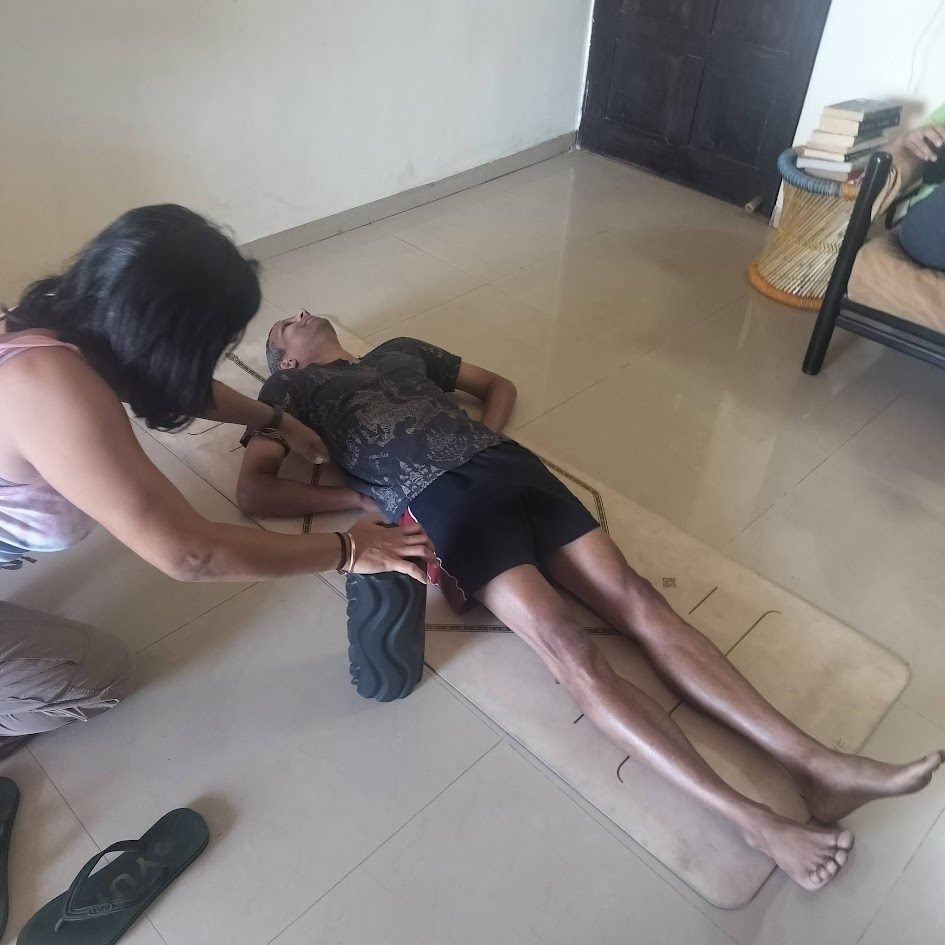
Matsyasana (supported) ⏱ 3–5 minutesPlace a rolled blanket or bolster horizontally across your mat at shoulder-blade level. Lie back over it so the support falls directly between your shoulder blades. Arms out to the sides, palms up. Let the chest open fully. Breathe slowly. This is the direct antidote to thoracic hyperkyphosis. You are using gravity to decompress the mid-back and stretch the pectoral muscles that desk work shortens. The vagus nerve stimulation here is significant — you should feel the nervous system shift within 60–90 seconds. This is also my personal favourite pose to prescribe after a long writing day. Two years of working on my book, and this pose saved my thoracic spine from becoming a permanent question mark.
Seated Spinal Twist
Ardha Matsyendrasana ⏱ 60–90 seconds each sideSit upright with legs extended. Bend one knee, place that foot on the floor outside the opposite thigh. Inhale to lengthen the spine. Exhale and rotate toward the bent knee, placing the opposite elbow on the outside of the knee. Hold and breathe. Rotation is the movement that desk work eliminates almost entirely. Your thoracic spine is designed to rotate. It doesn't, when you sit still facing a screen for eight hours. This pose restores that rotation — and the gentle compression and release of the abdominal organs also stimulates the vagus nerve through an entirely different mechanism. Two for one.
Downward Facing Dog
Adho Mukha Svanasana ⏱ 60–90 seconds · return 3–4 timesFrom hands and knees, tuck the toes and lift the hips up and back into an inverted V shape. Press firmly through the hands. Draw the shoulder blades toward each other and down the back. Let the head hang heavy. Bend the knees generously if the hamstrings are tight — straight legs are not the goal. Spinal decompression is. This pose tractors the entire spine — every vertebra gets space. It also reverses blood pooling in the legs from prolonged sitting. Pro athletes use this pose as a recovery tool between training blocks. It is not a beginner pose dressed up as accessible. It is a full-body reset.
Legs Up the Wall
Viparita Karani ⏱ 5–10 minutesSit sideways next to a wall and swing your legs up so they rest vertically against it. Your back is flat on the floor, arms by your sides. Breathe slowly. This is the easiest and most underrated pose for desk workers. Sitting pools blood and fluid in the lower legs. Legs up the wall reverses that drainage. The gentle inversion also shifts the nervous system into parasympathetic mode. For anyone who experiences afternoon energy crashes — which is nearly everyone who sits all day — this pose, done after lunch, does more than another coffee.
The Oldest Posture Instruction Ever Written
"Sthira sukham āsanam"
— Yoga Sutras of Patanjali, 2.46
Translation: The seat should be stable and at ease.
That's it. That's the entire postural instruction from the foundational text of yoga. Not "achieve a perfect shape." Not "hold it until it hurts." Stable and at ease. Sthira — steadiness, effort, alertness. Sukha — lightness, comfort, space. Both, simultaneously.
This is the opposite of what desk work does. Desk work produces either rigidity (braced, tense, frozen in position) or collapse (melted into the chair, unsupported). Neither is sthira sukha. The practice is finding the middle — active without straining, soft without collapsing. This is what every one of those six poses is training. Not a shape. A quality.
My Dad, who has been practicing yoga longer than I've been alive and still wins every argument because he cites both case law and the Gita, puts it simply: "You cannot think clearly from a collapsed spine. The body and the mind share the same posture."
He's right. He's also annoyingly consistent about it.
If you want to build this into a proper practice — not just six poses done randomly when the back complains — join regular classes at La Waha with me, Rohit, or Elaine at Silva Heritage. We run hybrid sessions. The physical work and the breath work happen together, which is the only way posture correction sticks long-term. Find us here.
Or if you want to understand how your dosha type affects your postural tendencies — Vata types collapse, Pitta types brace, Kapha types congeal — take the dosha quiz here and message me. It changes the approach entirely.

Your spine is the oldest conversation your body is having with gravity. After eight hours of sitting, you owe it something better than a neck roll and a vague intention to "stretch more." Twenty minutes. Six poses. Do it before dinner. Your psoas, your thoracic spine, and your nervous system will notice the difference before your brain does.
And Anuj, if you're reading this — I know you are — the Low Crescent Lunge. Start there. Just that one. You have my number.
Frequently Asked Questions
How long do I need to do yoga before my posture improves?
Research shows measurable structural improvements — including changes in thoracic kyphosis angle — in as little as 6–8 weeks of consistent practice. "Consistent" means 4–5 sessions per week of 20+ minutes, not a single long session on Sundays. The nervous system begins adapting within days. The structural muscle changes take longer.
Is yoga better than physiotherapy for desk-worker posture?
They're complementary, not competing. Physiotherapy is excellent for assessing dysfunction and addressing acute pain. Yoga builds the strength, flexibility, and proprioceptive awareness that maintains correction over time. The best outcomes — and the research supports this — come from combining both: physio to diagnose and release, yoga to rebuild and sustain.
My lower back hurts. Should I still do these poses?
With modification, yes — but consult a professional first if the pain is acute or radiating down the leg. Gentle Cat-Cow and Legs Up the Wall are almost universally safe even for lower back pain. Avoid deep backbends until the acute phase has passed. The Low Crescent Lunge should be done with care — focus on the hip flexor stretch rather than pushing the range of motion in the lumbar spine.
Can I do these poses at my desk without a mat?
The Seated Spinal Twist works in a chair. Cat-Cow can be done standing, hands on a desk. But Legs Up the Wall, Supported Fish, and the Lunge require floor space. The honest answer: five minutes away from your desk, on the floor, does more than any chair-based stretch. Find the space. Your spine is worth five minutes.
Does yoga for desk workers help with headaches and eye strain?
Often, yes. Many tension headaches originate in the cervical and upper thoracic spine — the same areas that desk posture compresses. Improving thoracic extension and releasing the suboccipital muscles (at the base of the skull) reduces referred headache pain. Eye strain from screen glare is a separate issue — though Viparita Karani (Legs Up the Wall) notably reduces systemic cortisol and can reduce stress-related eye tension.